One of the most notable changes is that students must now study the whole course – there will no longer be options or choices of topics that can be covered or omitted. The course structure will also change as the updated specification moves towards a more integrated and skills-based approach.
The course is divided into three contextual strands, with a unifying strand (applying geographical thinking and skills) running through all strands.
Strand 1: The Physical Environment
Strand 2: The Human Environment
Strand 3: The Global Environment
Unifying Strand: Applying Geographical Thinking and Skills
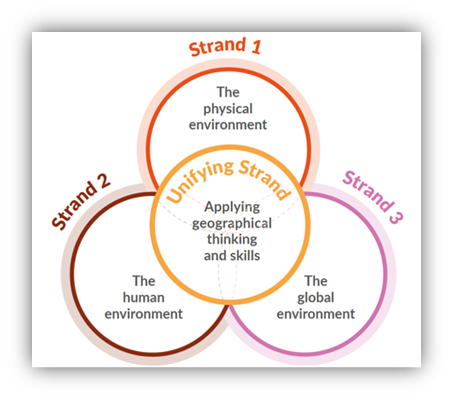
Each strand has a series of numbered learning outcomes (LOs) that students must have fulfilled by the end of each strand.
- In the Physical Environment strand, students will study topics that are familiar to them from Junior Cycle, including plate tectonics, rivers, coasts and the rock cycle, and new compulsory ones for Leaving Certificate level, such as weather, climate systems and climate change.
- The Human Environment strand covers topics such as population, migration, settlement and sustainable urban development.
- In the Global Environment strand, there is a stronger focus on economic geography. Students study agriculture, fishing and tourism, as well as human development, globalisation and geopolitics.
- Through the unifying strand, there is also a stronger focus on skills development, including map reading, data gathering, data analysis, fieldwork and geographical critical thinking, which encourages students to ask questions, interpret data, analyse patterns and evaluate different perspectives.
Assessment
The new course will include two forms of assessment: the written exam and the additional assessment component (Applied Geography Project).
The written exam
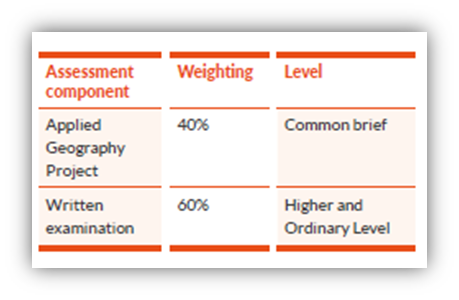
The final written exam is now worth 60% of the overall marks for Leaving Cert Geography. This exam will be designed to assess students’ knowledge and their ability to apply skills, such as interpreting maps, analysing data and evaluating geographical information. Questions will be set in a way that requires students to think critically and apply what they have learned.
The Applied Geography Project
The second component of assessment is the Applied Geography Project, which will make up 40% of the overall grade. This gives students an opportunity to demonstrate evidence of a deeper understanding of geographical concepts learned throughout the course, while also applying geographical thinking and skills from the unifying strand.
Students must carry out a geographical inquiry (investigation) and report related to a brief (topic) that is published each year by the State Examinations Commission (SEC).
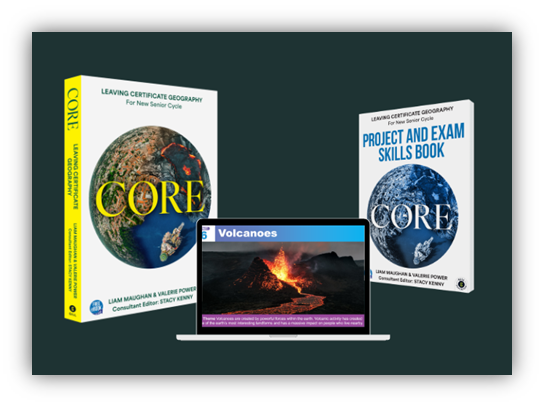
Core: Structured, thorough support for each strand and learning outcome
Valerie Power and I have carefully thought out and structured our new textbook Core to ensure that both you and your students have everything you need to easily navigate this new Geography specification, to be engaged and to excel at all aspects of this new and exciting course.