“The Whole Emphasis Is on Exams”: Inside Making History for Junior Cycle History
With new changes to the Junior Cycle History course, teachers and students have had to adapt quickly, particularly when it comes to assessment. For the authors of Making History, Dermot Lucey and Stacy Stout, the third edition was an opportunity to respond directly to those challenges.
“What’s new is the whole emphasis on exams and exam answering,” the authors explain. “Up to this point, teachers had little or no knowledge of how exams were marked and what style of answer was expected. So what we’re doing is giving them sample answers, showing how students would gain three marks or six marks or 15 marks … so they can use these examples in class and try to raise their students to those standards.”
Bringing exam practice into every chapter
A key feature of the new edition is how exam questions are integrated throughout the book.
“All of the exam questions have been put into the relevant chapters,” the authors say. “So students can learn the information and then test themselves afterwards with the sample questions at the end of the chapter.”
Alongside this, online quizzes provide further opportunities for independent learning. “They’re self-correcting, so students can literally test themselves. They know whether they’ve learned the material or whether they need to improve on certain topics.”
Building exam skills step by step
This exam focus runs consistently throughout the book.
“It starts easily … we break down how to construct a historical sentence,” the authors explain. “We show what’s involved in the statement, then how to develop it by adding historical information.”
From there, students build more advanced skills. “We show them how to analyse a picture or a poster or a cartoon, and then they can apply that knowledge to other questions.”
The aim is long-term progression. “It will build up right through the three years and, at the end of the three years, students will be ready to answer quite long questions.”
Responding to a new exam system
The shift to a new course has created uncertainty for teachers. “Teachers were very familiar with the old course, how it was questioned and how it was marked,” the authors say. “But this is a new course. The style of question is totally different, and there are no marks on the exam paper.”
This lack of clarity can be challenging. “Neither the teacher nor the student knows what’s expected … until a marking scheme comes out, you don’t know exactly what marks are allocated.”
Making History is designed to address this directly. “What we do is provide the guidelines through the textbook and the skills book to help teachers and students approach the exams in a professional way.”
Clear structure, strong visuals
The way information is presented is another key strength of the book.
“Each chapter is full of colour,” the authors explain. “It’s broken down by questions or subheadings, so the main topic is taken step by step.”
Topics are carefully structured to support understanding. “For example, the Age of Exploration is broken down into causes, explorers and impacts, so it’s easier for students to follow and learn.”
The book is also highly visual. “There are pictures, maps, cartoons, posters and mind maps, which help students break down the knowledge.”
At the end of each chapter, students can consolidate learning. “You’ve got review questions, source questions and the exam focus.”
Supporting both students and teachers
The connection between the textbook and skills book is designed to support learning.
“There are page references between both. Students answering questions in the skills book are often referred back to the textbook if they need the relevant information.”
Each section also includes “Assessing Your Learning” questions. “Teachers can use these as homework. Students can then go to the skills book for further questions on the same topic.”
Helping manage time and mixed ability
The length of the course presents a challenge for many teachers.
“In some cases, teachers fail to complete the course in three years,” the authors note.
To support this, each chapter includes a summary. “It breaks down the key information, which is very useful for weaker students … they have all the key points rather than the full chapter.”
The visual nature of the book also helps with engagement. “Students might recognise names like Muhammad Ali and realise he has an Irish connection – that creates interest and helps them engage with the material.”
Building teacher confidence
For teachers navigating a new course, confidence is critical.
“In the book, we’re providing the guidelines – from the very basic questions to the longer questions, to the structure of a question,” the author says.
The impact is clear. “This will give teachers the confidence to know the standard that’s expected in the exam and they’ll be able to translate that for their students.”
Asked to summarise the book, the authors’ answer reflects its core purpose: “Exam focused, student friendly, up-to-date.”
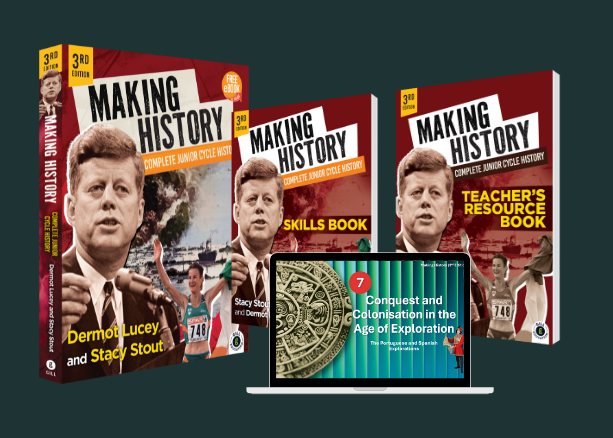
To see how Making History 3rd ed can support your Junior Cycle classroom, contact your local Gill Education representative today.